Your Ad Here

Thursday, October 22, 2015

New tech allows cows’ weights to be monitored from space

SYDNEY: Australian farmers managing cattle stations as large as some European nations will soon be able to monitor their cows and pastures from space as part of ‘groundbreaking’ technology, scientists say.

The technology, developed with government and private funding, taps into a satellite passing overhead to record the weights of herds daily while monitoring pasture conditions — a task traditionally impossible due to the stations’ vast sizes and harsh, remote locations.

Some stations, such as Newcastle Waters in the Northern Territory, span 10,000 square kilometres — an area larger than Cyprus — and home to 55,000 cattle.

Australia is one of the world’s largest beef exporters.

“There’s just a huge labour component and time that goes into collecting that data (of weight and pastoral conditions), which is essentially why producers don’t do it on a more regular basis,” Sally Leigo from the Northern Territory’s primary industry department, the project’s research leader, told AFP yesterday.

On average, cattle are only weighed 1.5 times a year and only two percent of pasture is regularly viewed, the Cooperative Research Centre for Remote Economic Participation, the private-public funded organisation that developed the tool, estimates.

The technology exploits the stations’ semi-arid conditions, which means there is little access to surface water with cattle having to walk to man-made watering points each day.

A weighing platform that the cows — which each have an electronic tag — must step on is placed at the watering points and powered by solar panels, with the data fed to a satellite and then to a station manager’s computer.

The satellite also monitors pastures every 250 metres, allowing farmers to determine when cattle must be moved to the next paddock.

“The global demand for beef is booming at the moment,” said Murray Grey, whose family has for three decades run the remote West Australian 1,970-square-kilometre Glenflorrie station, one of the five taking part in the trial before a public showing next week.

“We’ve haven’t got the room … to breed more cows, but we have got the room to make the cows that we have got produce more efficiently.

“Ultimately, it’s getting that animal to market quicker,” Grey added, saying the technology would boost efficiencies in the lucrative business, such as cutting costs and lifting revenue, by 25 to 40 percent.

While farmers traditionally look for a visual change in a herd to determine when they are losing weight and their feed needs to be refreshed, the technology will allow them to monitor this almost instantaneously.

“There’s a lot of systems still in place on pastoral stations that haven’t changed in over 100 years … and it’s great for our industry to finally be in pace with the technological world,” Grey said.

Leigo said she was hopeful the technology would become commercially available to cattle stations worldwide by 2017. — AFP


Read more: http://www.theborneopost.com/2015/10/23/new-tech-allows-cows-weights-to-be-monitored-from-space/#ixzz3pN6IpfDm

Cattle population under control at councillor’s farm

SERIAN: State Councillor Sunny Kon who rears Bali cattle has to impose some control to prevent them multiplying too fast as there would not be enough room to roam.

Kon said there were over 100 heads of Bali cattle on his 10-acre farm.

“Without some control, the population could have easily increased quite a lot because as we all know Bali cattle multiply faster. I need to impose some control on reproduction because of the limited space available,” he said.

He disclosed this when briefing a delegation from Terengganu Veterinary Department which made a study tour to his farm here yesterday.

According to Kon, he started breeding Bali cattle also known as ‘banteng’ or ‘tembadau’ about 10 years ago with only eight heads and within that period the number had multiplied more than 10-fold.

“I have not sold any of them. My plan is to breed as many as possible first and pass down the breed to others interested in the future.

“Bali cattle bred well in Serian. The problem is that the land I am using is only about 10 acres for about 100 heads of cattle,” he said.

Kon said he had identified a 200-acre piece of land nearby but at this stage he was still unable to move in as everything, including the infrastructure, was not ready.

“Having that size of land I am confident the population of Bali cattle in the state will expand very fast and one day Sarawak can become a major supplier of Bali cattle calves in this region,” he said.

He said to achieve this vision sooner, the government could come in to assist potential farmers.


Read more: http://www.theborneopost.com/2015/10/21/cattle-population-under-control-at-councillors-farm/#ixzz3pIzrFQO0

Tuesday, October 20, 2015

Possible to rear wild Bali cattle

SERIAN: A delegation of 10 officers from Terengganu Veterinary Department on a study tour discovered that it’s possible to rear the wild Bali cattle.

Terengganu veterinarian delegation leader Dzulkafli Hamzah said they had heard that Bali cattle could be set free to roam in the wild, not enclosed in farms.

“Some plantation operators in Terengganu had tried to rear Bali cattle as part of integrated farming, but most of them failed.

“The planters would release the cattle on their plantations and allow them to graze and roam freely. As Bali cattle are wild they would forage for food in the jungle and not return,” he said.

He said this was the experience of those trying to rear Bali cattle on oil palm plantations as part of integrated farming.

“After witnessing the successful breeding of Bali cattle in Sarawak, we look forward to learn more to introduce them here,” he said.

Dzulkafli said this when leading the delegation to visit Serian Bali cattle farm owned by Councillor Sunny Kon here yesterday. They were accompanied by a few State Agriculture Department officers and veterinarians.

A senior member of the delegation from Terengganu Shamsudin Mamat said this was the first time he saw such a huge herd of Bali cattle being reared like cows.

“It’s amazing that Bali cattle can be reared like tame species. They don’t seem as wild as we thought,” he said.

He said the government should encourage more people to venture into Bali cattle breeding and rearing, with a ready model available.

“I’m sure councillor Sunny (Kon) is more than willing to share his experience with those serious about running the business,” he said.

He said the meat of Bali cattle was softer than normal cows – similar to deer, some claim.

The delegation comprising mostly retiring officers was brought to Kon’s farm for an educational visit.

“We hope to learn about Bali cattle breeding and rearing. And if time permits, return with some calves to Terengganu,” Samsudin said in jest.

On their arrival at the farm yesterday the delegation was briefed by Samarahan assistant veterinary officer (AVO) Parag Kaweh.

Those attending the briefing included state veterinarian Dr Nicholas Jenek, Serian district senior assistant agriculture officer (SAAO) Tedwin Beti, Kon and a few local businessmen.


Read more: http://www.theborneopost.com/2015/10/21/possible-to-rear-wild-bali-cattle/#ixzz3p9ixfsFG

Possible to rear wild Bali cattle

SERIAN: A delegation of 10 officers from Terengganu Veterinary Department on a study tour discovered that it’s possible to rear the wild Bali cattle.

Terengganu veterinarian delegation leader Dzulkafli Hamzah said they had heard that Bali cattle could be set free to roam in the wild, not enclosed in farms.

“Some plantation operators in Terengganu had tried to rear Bali cattle as part of integrated farming, but most of them failed.

“The planters would release the cattle on their plantations and allow them to graze and roam freely. As Bali cattle are wild they would forage for food in the jungle and not return,” he said.

He said this was the experience of those trying to rear Bali cattle on oil palm plantations as part of integrated farming.

“After witnessing the successful breeding of Bali cattle in Sarawak, we look forward to learn more to introduce them here,” he said.

Dzulkafli said this when leading the delegation to visit Serian Bali cattle farm owned by Councillor Sunny Kon here yesterday. They were accompanied by a few State Agriculture Department officers and veterinarians.

A senior member of the delegation from Terengganu Shamsudin Mamat said this was the first time he saw such a huge herd of Bali cattle being reared like cows.

“It’s amazing that Bali cattle can be reared like tame species. They don’t seem as wild as we thought,” he said.

He said the government should encourage more people to venture into Bali cattle breeding and rearing, with a ready model available.

“I’m sure councillor Sunny (Kon) is more than willing to share his experience with those serious about running the business,” he said.

He said the meat of Bali cattle was softer than normal cows – similar to deer, some claim.

The delegation comprising mostly retiring officers was brought to Kon’s farm for an educational visit.

“We hope to learn about Bali cattle breeding and rearing. And if time permits, return with some calves to Terengganu,” Samsudin said in jest.

On their arrival at the farm yesterday the delegation was briefed by Samarahan assistant veterinary officer (AVO) Parag Kaweh.

Those attending the briefing included state veterinarian Dr Nicholas Jenek, Serian district senior assistant agriculture officer (SAAO) Tedwin Beti, Kon and a few local businessmen.


Read more: http://www.theborneopost.com/2015/10/21/possible-to-rear-wild-bali-cattle/#ixzz3p9bAhefc

Saturday, September 26, 2015

Cattle Feedlot for Korban

Prior to entering a feedlot, cattle spend most of their life grazing on rangelandor on immature fields of grain such as green wheat pasture. Once cattle obtain an entry-level weight, about 650 to 700 pounds (300 kg), they are transferred to a feedlot to be fed a specialized animal feed which consists of corn, corn byproducts (some of which is derived from ethanol and high fructose corn syrup production), milo, barley, and other grains as well as roughage which may consist of alfalfa, corn stalks, sorghum, or other hay, cottonseed meal, and premixes composed of microingredients such as vitamins, minerals, chemical preservatives,antibiotics, fermentation products, and other essential ingredients that are purchased from premix companies, usually in sacked form, for blending into commercial rations. Because of the availability of these products, a farmer who uses his own grain can formulate his own rations and be assured his animals are getting the recommended levels of minerals and vitamins.[6] In the American northwest and Canada, barley, low grade durum wheat, chick peas (garbanzo beans), oats and occasionally potatoes are used as feed.[citation needed]

In a typical feedlot, a cow's diet is roughly 62% roughage, 31% grain, 5% supplements (minerals and vitamins), and 2% premix. High-grain diets lower the pH in the animals' rumen. Due to the stressors of these conditions, and due to some illnesses, it may be necessary to give the animals antibiotics on occasion. [7]

Feedlot diets are high in protein, to encourage growth of muscle mass and the deposition of some fat (known asmarbling in butchered meat). The marbling is desirable to consumers, as it contributes to flavor and tenderness. The animal may gain an additional 400 pounds (180 kg) during its approximate 200 days in the feedlot.[citation needed]Once cattle are fattened up to their finished weight, the fed cattle are transported to a slaughterhouse.


Monday, September 14, 2015

Cattle Integration with Oil Palm Plantation

Veterinary Division, Department of Agriculture identified the need to integrate cattle-rearing, representing the upstream segment of beef production, with the downstream, production segment. Following this, EPP Livestock: Full Value Chain was developed to incentivise downstream players to move upstream and vice versa through collaboration with players under EPP 5: Expansion of Cattle Integration with Oil Palm.

In Sarawak, this Programme targets the integration of 50,000 more heads of cattle in more than 1.5 million hectars of palm oil plantations in order to meet it 50% self sufficiency level by 2030. 


Sunday, August 9, 2015

Murrah Buffalo at Batu Danau

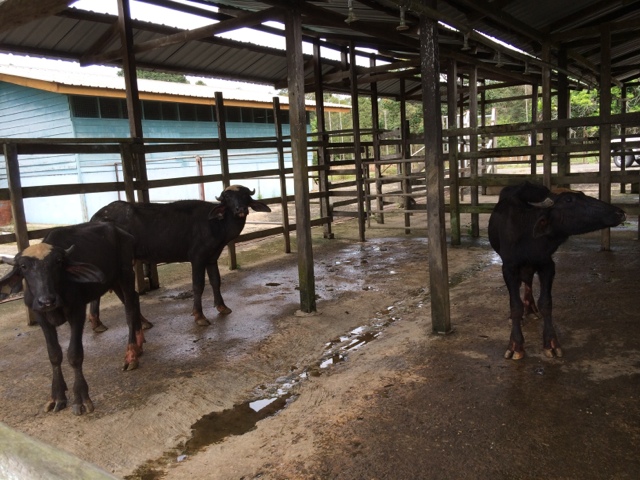
Batu Danau Murrah Buffalo Station in Limbang housed more than 50 Murrah Buffalo.