Your Ad Here

Saturday, September 26, 2015

Cattle Feedlot for Korban

Prior to entering a feedlot, cattle spend most of their life grazing on rangelandor on immature fields of grain such as green wheat pasture. Once cattle obtain an entry-level weight, about 650 to 700 pounds (300 kg), they are transferred to a feedlot to be fed a specialized animal feed which consists of corn, corn byproducts (some of which is derived from ethanol and high fructose corn syrup production), milo, barley, and other grains as well as roughage which may consist of alfalfa, corn stalks, sorghum, or other hay, cottonseed meal, and premixes composed of microingredients such as vitamins, minerals, chemical preservatives,antibiotics, fermentation products, and other essential ingredients that are purchased from premix companies, usually in sacked form, for blending into commercial rations. Because of the availability of these products, a farmer who uses his own grain can formulate his own rations and be assured his animals are getting the recommended levels of minerals and vitamins.[6] In the American northwest and Canada, barley, low grade durum wheat, chick peas (garbanzo beans), oats and occasionally potatoes are used as feed.[citation needed]

In a typical feedlot, a cow's diet is roughly 62% roughage, 31% grain, 5% supplements (minerals and vitamins), and 2% premix. High-grain diets lower the pH in the animals' rumen. Due to the stressors of these conditions, and due to some illnesses, it may be necessary to give the animals antibiotics on occasion. [7]

Feedlot diets are high in protein, to encourage growth of muscle mass and the deposition of some fat (known asmarbling in butchered meat). The marbling is desirable to consumers, as it contributes to flavor and tenderness. The animal may gain an additional 400 pounds (180 kg) during its approximate 200 days in the feedlot.[citation needed]Once cattle are fattened up to their finished weight, the fed cattle are transported to a slaughterhouse.


Monday, September 14, 2015

Cattle Integration with Oil Palm Plantation

Veterinary Division, Department of Agriculture identified the need to integrate cattle-rearing, representing the upstream segment of beef production, with the downstream, production segment. Following this, EPP Livestock: Full Value Chain was developed to incentivise downstream players to move upstream and vice versa through collaboration with players under EPP 5: Expansion of Cattle Integration with Oil Palm.

In Sarawak, this Programme targets the integration of 50,000 more heads of cattle in more than 1.5 million hectars of palm oil plantations in order to meet it 50% self sufficiency level by 2030. 


Sunday, August 9, 2015

Murrah Buffalo at Batu Danau

Batu Danau Murrah Buffalo Station in Limbang housed more than 50 Murrah Buffalo. 


Swamp Buffalo at Maragang

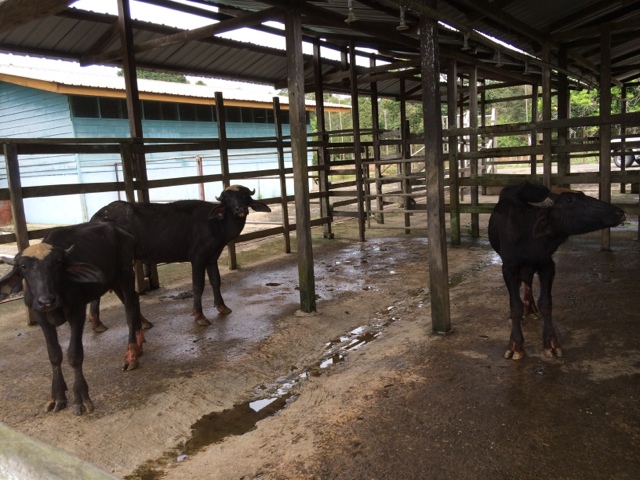
Maragang Buffalo Station housed more than 300 heads of Swamp Buffalo in Lawas, Sarawak


Saturday, April 25, 2015

Bali Cattle

BALI CATTLE

 Bali cattle are indigenous to Indonesia and were domesticated directly from wild banteng (Bos javanicus syn. Bos sondaicus syn. Bibos banteng).

FEMALE

MALE

Origin of Cattle

The origin of Bali cattle, Bos javanicus d’Alton, in Indonesia, is a part of the complex evolution of all cattle over a long time. The earliest known type of wild cattle, Bos acutifrons comes from a part of a fossil found in India (Payne 1970). The wild cattle then developed into to streams: the aurochs (Bos primigenius) that inhabited the forests of Asia, North Africa and Europe; and the urus (Bos namadicus) found in India and other parts of Asia. Most views expressed on the origin of the cattle focus on the auroch as the foundation of most of the cattle species and breeds developed in the world. The auroch, although an ancient cattle type, has survived into historical memory as the last recorded animal was killed in a Polish forest in the seventeenth century. They were large animals with enormous horns, the latter a characteristic found in modern cattle species.

Very little is known of the origin of Bos (Bibos) type cattle in Southeast Asia. The geographical distribution of Bos (Bibos) types of cattle suggests that the centre of domestication was Indo-China and Malaysia, later spreading to Bali. The other centre of domestication was probably Assam-Burma and led to the development of the gayal. Indonesia probably became the centre of Bali cattle domestication some ten to five thousand years ago. The process of domestication probably started in prehistoric times on Bali and Java. There are two types of Bali cattle in Indonesia, a domestic type, called Bali cattle and a wild type named banteng. There are not many wild bantengs left in Indonesia. They are now mainly found in the national parks such as Ujung Kulon and Baluran.

The uniqueness of Bali cattle

Bali cattle are different from all other species of cattle as results of their origin and evolution. They will crossbreed with European cattle, Bos Taurus, but the male offspring as reported by Jellinek et al. (1980), is usually infertile. Bali cattle do have some distinct characteristics which have made them the cattle breed of choice in many parts of Indonesia. Difference between Bali cattle and Bos Taurus and Bos indicus may influence their responses to physiological and pathological events such Jembrana diseaseand may explain the variation seen in the susceptibility observed in the field. Some of the unique differences of Bali cattle from other cattle which make them valuable assets in Indonesia are:


Size

Smaller than Zebu and European cattle

Colour

Strickingly uniform markings

Behaviour

Timid and can become wild readily

Reproduction

High conception rates

Lactation

Ability to stop lactating and survive a bad dry season

Feed utilization

Better able to utilize low quality feed base

Heat tolerance

Better heat tolerance than buffalo and other cattle

Water turnover

Lower water turnover than Bos Taurus

Meat quality

Marked fat deposition sites and limited fat in muscle mass

Disease pattern

Stated to be resistant to external and internal parasites except liver fluke,Fasciola gigantica. Increased resistance to malignant catarrhal fever and Jembrana disease

Distribution

Bali island is recognized as the main source of pure Bali cattle. From Bali, they spread to other parts of Indonesia, and to Malaysia and Australia. Bali cattle were imported to Lombok island by the ancient monarch and Lombok subsequently became the second source of pure Bali cattle. They were introduced to South Sulawesi in the 1890s and to Java in 1907. They performed satisfactorily in South Sulawesi and Mojoagung, East Java, but unsuccessfully in West Java, due to malignant catarrhal fever, a virus infection carried by sheep. Bali cattle were then introduced to Timor, Sumbawa, the Moluccas, Irian Jaya (Papua), Sumatera and Kalimantan.

Further reading:

Bali cattle : Origins in Indonesia. J.W. Copland. Jembrana Disease and the Bovine Lentiviruses. ACIAR PROCEEDING No 75


Plan to introduce Bali cattle breed to Sabah

SERIAN: Agriculture Department officials from Semporna, Sabah are looking into the possibility of bringing the Bali cattle breed over to their state.


Leading a delegation from the department in Semporna on a study tour of the state, Agriculture Officer (AO) Abd Samat Injau said he was impressed by how well the breed was doing at the Serian Bali cattle farm.


“It’s amazing that the cattle can thrive under local conditions. I’m thinking of introducing this breed to cattle farmers back in Semporna or import them myself,” Abd Samat said. He said cattle rearing in Sabah and Sarawak had great potential though certain breeds cannot survive well under local conditions.


“In Sabah the demand for sacrificial meat during Hari Raya Korban is very high and I think it’s the same in Sarawak. The shortage of supply during this period is the reason cattle can fetch RM5,000 to RM6,000 per head,” Abd Samat said during a visit to the Bali cattle farm owned by Cr Sunny Kon here yesterday.

Briefing the 18-member delegation, Kon said he was ready to share his experience in Bali cattle rearing with anyone interested.


“I started rearing Bali cattle as a hobby about 10 years ago with less than 10 heads, which have multiplied to more than 100 today,” he said. Kon said the species scientifically known as Bos javanicus was easy to rear, as being wild, they could survive on almost anything.

“We just release them to graze by themselves. We don’t provide them with pellets or additional nutrition yet they stay healthy,” he said. Kon has not sold any of the cattle to allow them to multiply.


“My plan is to breed as many as possible before passing down the breed to anyone interested,” he said. However his cattle cannot multiply fast enough as his farm is only 10 acres, otherwise he could have started supplying the species to interested local farmers.


Samarahan Assistant Veterinary Officer Parag Kawah who turned up for the study trip said Kon was the only known successful Bali cattle breeder in the state so far, but Kon’s farm did not have enough space to speed up growth of the herd.


Parag would like to make recommendations to the Agriculture Ministry to encourage Bali cattle breeding so the state would not be overly dependent on imported meat. He said Bali cattle would be the best substitute for imported frozen meat but the state government and local community had to increase the scale of breeding. Bali cattle farms can also become important eco-tourism products.


“I believe many animal lovers would like to visit the farms but proper facilities must be there,” Parag said. Other visitors at the farm yesterday were two Serian District Council (SDC) councillors Senior William Rade and Lawas Musan.


Read more: http://www.theborneopost.com/2015/04/23/plan-to-introduce-bali-cattle-breed-to-sabah/#ixzz3Y5cmzqjs

Sunday, December 7, 2014

Cattle Abattoir in Perth

KUALA LUMPUR, Dec 3 (Bernama) -- Hong Leong Investment (HLIB) Bank has maintained its "hold" call on Brahim's Holdings Bhd, following the company's joint venture (JV) with Australian-based Carpenter Beef Pty Ltd, for the development of the Cataby Abattoir in Perth.

The research house said it was surprised at the JV as this allows Brahim's to obtain raw material consistently and at a better pricing.

"Brahim's has also majority control of the JV. Hence, it will be able to consolidate the financials of it.

"We believe the JV will benefit Brahim's through costs savings, while enabling the group to have control over the quality of raw materials," it added in a note Wednesday.

Brahim's in-flight catering business consumes one tonne of beef weekly and its Burger King venture is evenly split between beef and chicken on its menu.

"The target price remains unchanged for now at RM1.43," HLIB said.

At 11.55 am, Brahim's share price stood at RM1.40.

-- BERNAMA