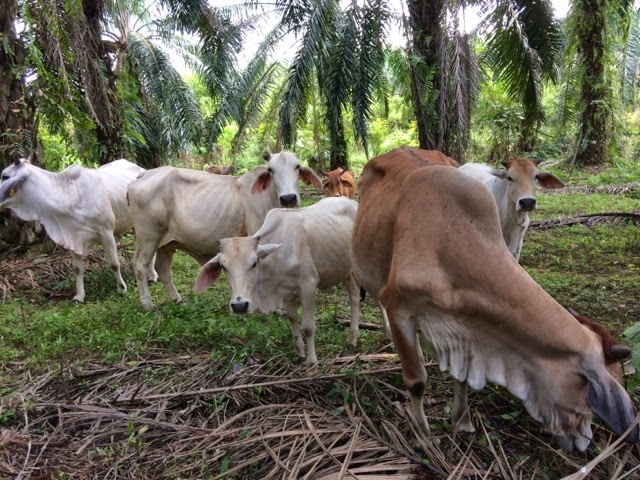
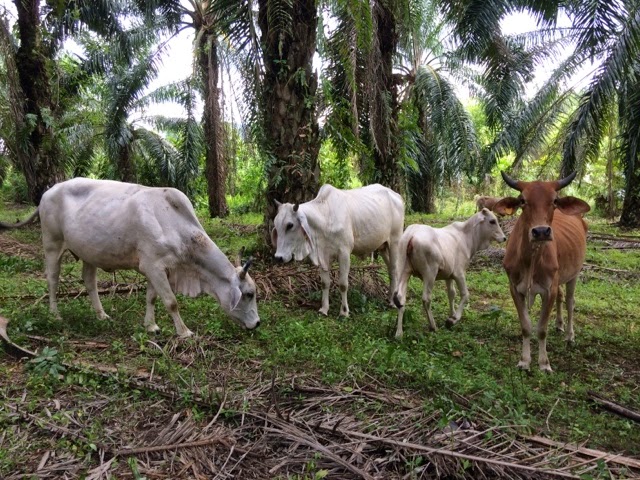
An outsider would wonder why the Lun Bawang community, known for their gentleness and refined manner would leave the animals, with their backswept horns, roaming freely on the range.
On closer look, the buffalo herd here does more than just discharge publicly on the road or dotting all the small concrete trails linking houses here, that the visitor might do well to dodge.
“Buffaloes are important to us. Without the buffaloes, we can’t produce the Adan rice that we are having now,” village chief of Long Muda Yudan Meru told the BAT IV team yesterday.
Every year after harvest between January and February, the paddy field will be left to lie fallow. During this time, buffaloes will be free to roam in the paddy field to ‘till’ the land as they trample on it leisurely while grazing on whatever is left after harvesting.
At the same time while ‘tilling’ and ‘clearing’, buffaloes also enrich the paddy fields with their dung. Adan rice is thus fully organic.
It is a natural cycle that has been taking place for hundreds of years and the Lun Bawang community has incorporated that natural cycle into their way of life.
For Yudan who has three plots of paddy fields of about two acres, two buffaloes are enough to execute the job. Buffalo dung is never a nuisance to the Lun Bawang community here, and so too it should be viewed by visitors. The Asian ox is, if anything, treated with quiet reverence.
The Adan rice would not taste as it is without the ubiquitous buffalo and its rich manure. And without Adan Rice, the Lun Bawang community will lose one of its distinctiveness and the main source of income.
The rice strain, according to Yudan, originated from Indonesia. It was the choice of the Lun Bawang forefathers, after testing many other rice species, stuck with it for its higher yield and the best texture. It is called as such after one of their ancestors by the name of ‘Adan’.
“Bario rice is actually Adan rice. They took the seeds from us. It is just that the Kelabit community managed to market it better than us. Now, Bario rice is more famous than Adan Rice and fetches better price. So if we want to fetch more, we have to packet our Adan rice as Bario rice,” said Yudan.
The cycle of planting must follow that the dates set by their ancestors – one that follows the rhythm of nature. After harvesting between January and February, the land will be left to lie fallow until Aug 9. Meanwhile, a nursery has to be prepared in July for transplanting of the seedlings in August. There can only be one crop each year. Any mess-up of the dates will result in scanty yield and poor harvest.
“For example, transplanting must be done from Aug 9 onwards and not earlier. A few families tried to start their nursery earlier and planting early. (And) Their crop ended up not growing well and yielded only half of what we usually harvested.
“That is why everyone now follows the dates set by our ancestors, whom we believe have tested everything and handed to us their most precious experience,” said Supang Gatum, 47, who has moved to Miri and has been employing farm hands to work her paddy field in Ba Kelalan.
Different from Bario, there is still quite a high number of young people staying put in Ba Kelalan. Young farm hands are not difficult to source locally and Adan rice planting is still vibrant, constituting to be the main income earner for the Ba Kelalan.
Supang, who has four plots of land, is able to harvest more than 60 gunny sacks of Adan rice. She will keep about 10 of them for her family’s consumption while the rest will be sold as premium rice in Miri.
From The Borneo Post